On December 29, 2024, at 9:07 AM KST (00:07 UTC), Jeju Air Flight 2216
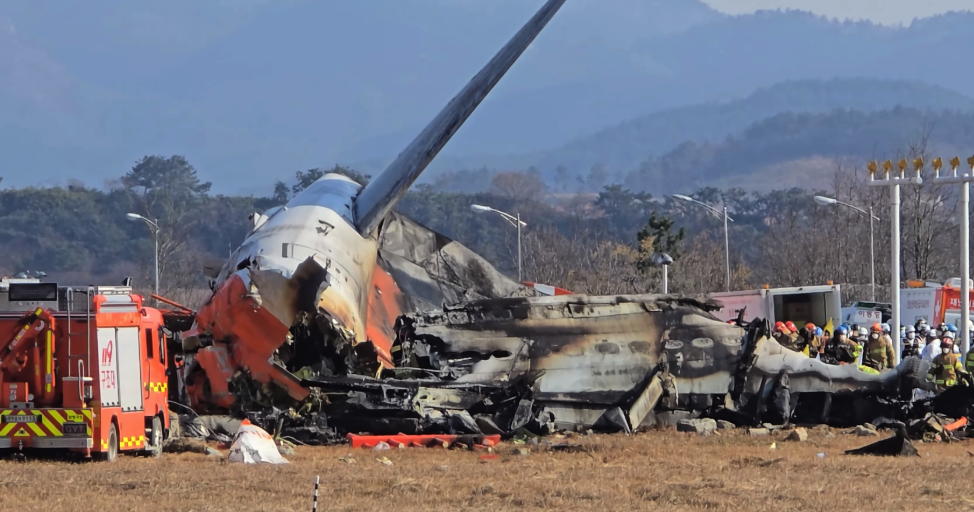
became South Korea’s deadliest aviation disaster. The Boeing 737-800 aircraft (registration HL8088), carrying 181 people—175 passengers and 6 crew members—made a belly landing without its landing gear deployed. The aircraft overran the runway, collided with a concrete structure, and erupted in flames. Of the 181 people aboard, 179 perished. Only two flight attendants, seated in the rear cabin, survived.
This remains the deadliest single-aircraft accident in South Korean aviation history and raises critical questions about emergency procedures, cockpit decision-making, and airport infrastructure safety.
The Flight and Early Warning
The Boeing 737-800 departed from Bangkok’s Suvarnabhumi Airport (BKK) at approximately 4:30 AM local time on December 29, 2024. The flight departed roughly one hour behind schedule. During the four-and-a-half-hour flight to Muan International Airport (MWX) in South Korea’s Jeollanam Province, the aircraft experienced no reported anomalies. Pre-departure maintenance records showed no discrepancies, and the captain had accumulated over 7,500 flight hours.
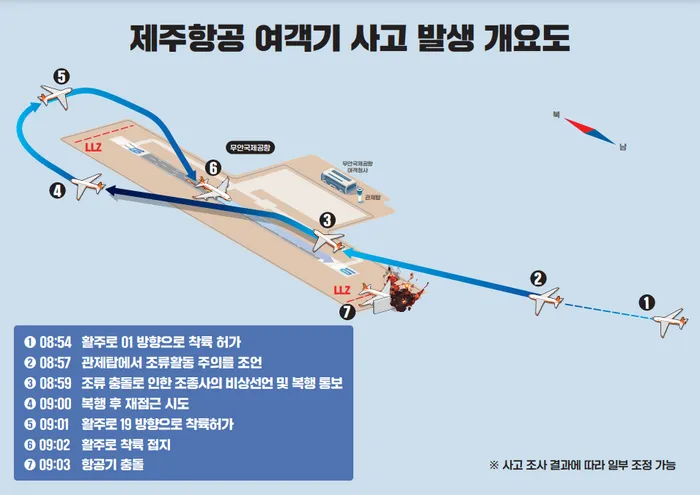
The critical phase began during descent. At 8:54:43 AM, the flight crew contacted Muan Air Traffic Control (ATC) and received clearance to land on runway 01. Just three minutes later, at 8:57:50 AM, ATC issued a caution: bird activity had been detected near the runway. The warning would prove prophetic.
The Bird Strike and First Go-Around
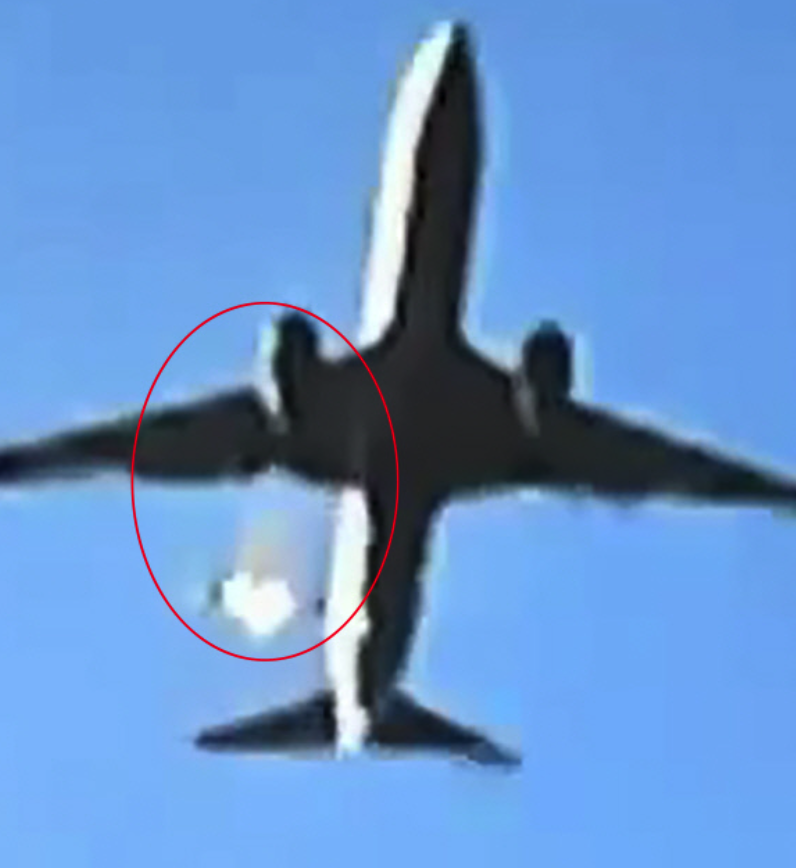
At approximately 8:57:50 AM, during the instrument landing system (ILS) approach to runway 01, Jeju Air 2216 encountered a severe bird strike. Eyewitness videos documented smoke and flames emanating from one of the engines. The strike was violent enough to damage at least one engine critically.

At 8:59 AM, the captain declared a Mayday emergency and requested a go-around. The crew initiated the standard emergency procedure: retracting flaps and landing gear to abort the landing and gain altitude for a second attempt. The aircraft climbed away from the runway.
During those critical moments between the bird strike and the decision to re-attempt landing, the flight crew faced a cascade of challenges. With one engine severely damaged and systems to diagnose and address the emergency, the crew worked rapidly. The investigation would later reveal that at this point—just 19 seconds after the bird strike—the crew shut down the left engine. According to preliminary findings released in July 2025, this was a catastrophic error: the left engine was less damaged and was operating normally. The damaged right engine, though it had surged and emitted flames and black smoke, was confirmed to be generating sufficient power for continued flight.
The Second Approach and the Belly Landing
At 9:00 AM, just one minute after declaring the go-around, the pilots requested authorization to attempt landing on runway 19—the reciprocal direction of runway 01, using the same physical runway from the opposite end. Air Traffic Control cleared them for this approach.
The crew performed a steep descent (a “teardrop turn”) to position the aircraft for this emergency landing. At 9:02 AM, the Boeing 737 touched down on runway 19 approximately 1,200 meters (3,900 feet) down the runway from the threshold—far beyond the normal touchdown zone of the first 300 meters. Critically, the landing gear had not been deployed.
The aircraft made a belly landing—sliding on its fuselage across the concrete runway at high speed. Friction alone could not slow the aircraft sufficiently. Without the normal braking provided by landing gear, hydraulic brakes, and deployed spoilers, the aircraft overran the runway.
At 9:03 AM, still traveling at high speed (estimated at 155 knots or 286 km/h when it departed the runway), the aircraft struck a concrete embankment—a berm supporting an antenna structure for the instrument landing system (ILS) near the runway’s southern end. This structure, approximately 264 meters from the runway’s end, was designed to withstand impacts and did not disintegrate on collision.
The frontal impact destroyed the aircraft’s forward fuselage and ignited a post-crash fire. The main cabin was consumed almost immediately. Only the rear fuselage, which detached during the crash, remained largely intact. The two cabin crew members seated in this section survived with injuries. All 175 passengers and 4 of the 6 flight crew members perished.
Critical Investigation Findings: A Pilot Error ?
The Aviation and Railway Accident Investigation Board (ARAIB) released preliminary findings in January 2025 but conducted further analysis. On July 19, 2025, investigators presented interim findings to victims’ families, revealing the likely sequence of events that converted a manageable emergency into a catastrophe.
The wrong engine was shut down. Cockpit voice recorder transcripts revealed that the captain issued the command: “Shut down engine number two,” referring to the right engine that had been damaged by the bird strike. However, investigators found that the crew actually shut down the left engine—which sustained less damage and was operating normally. The right engine, despite showing visible damage (surging, flames, and black smoke), was confirmed to be generating sufficient thrust for flight.
Critically, by shutting down the functioning left engine, the crew lost essential electrical and hydraulic power. These systems are essential for deploying the landing gear. The Boeing 737’s landing gear can be deployed manually as an emergency procedure, but only if hydraulic or electrical power is available. With the operational engine shut down and only the damaged right engine operating, the aircraft may have lacked sufficient power to execute the manual landing gear extension procedure.
The timeframe was catastrophic. Between the bird strike at 8:57:50 AM and the touch-down at 9:02 AM—just over four minutes—the crew faced multiple simultaneous crises: assessing engine damage, executing a go-around, declaring an emergency, performing urgent procedures, and re-positioning for landing. This compressed timeline may have contributed to procedural failures.
Both engines showed evidence of bird ingestion. Post-crash examination found duck remains in both engines, though the right engine sustained more severe damage.
However, this conclusion remains disputed by victims’ families and pilot unions,
The ARAIB interim findings suggest (rather than definitively conclude) that the pilot may have mistakenly shut down the left engine. However, this conclusion remains disputed by victims’ families and pilot unions, who argue that the investigation has not fully disclosed cockpit voice recorder and flight data recorder evidence, and that the focus on pilot error obscures systemic infrastructure failures.
Systemic and Infrastructure Factors
While the immediate cause appears to involve pilot error in engine shutdown, the investigation has identified multiple contributing factors that allowed a manageable emergency to become a mass casualty event.
Runway safety infrastructure. The concrete embankment structure that destroyed the aircraft violated international standards. The International Civil Aviation Organization (ICAO) Annex 14 requires that structures within a runway’s safety area must be made of “frangible” materials—designed to crumble or yield on aircraft impact rather than resist it. The Muan Airport localizer support structure was constructed of reinforced concrete, creating a rigid barrier. This structure was positioned approximately 264 meters from the runway’s end, within the safety area where aircraft overruns are survivable incidents if infrastructure is properly designed.
Had the structure been frangible or absent, the aircraft would have decelerated through the safety zone, and many or all occupants might have survived. Instead, the concrete structure proved to be the single most lethal factor. The impact destroyed the forward fuselage, and the post-crash fire eliminated any possibility of evacuation from the main cabin.
Lack of engineered braking systems. Muan Airport was not equipped with an Engineered Material Arresting System (EMAS)—a specialized safety system designed specifically to stop overrunning aircraft. EMAS has been in use at major airports worldwide since the late 1990s. The system consists of a specially engineered cellular material (typically expanded polystyrene blocks) that crushes under aircraft weight, rapidly decelerating the aircraft through friction and energy absorption. EMAS has proven effective in numerous overrun incidents, reducing fatalities to near zero in comparable scenarios.
Bird hazard management. Muan Airport is located near reclaimed tidal flats used as a water reservoir. This area overlaps a migration route for migratory waterfowl, particularly during winter months. Although ATC issued a bird warning at 8:57:50 AM, the warning came at the critical moment of final approach and provided minimal time for the crew to react. The effectiveness of bird-strike prevention measures—radar detection systems, habitat management, and warning protocols—remains under investigation.
Investigation Status and Broader Implications
The ARAIB investigation remains ongoing as of 2025. The preliminary findings released in July 2025 represent interim conclusions based on available evidence. A final report is expected by June 2026.
The National Transportation Safety Board (NTSB) of the United States and Thailand’s Aircraft Accident Investigation Office (AIIT) are participating in the investigation as accredited representatives, consistent with international protocols for accidents involving aircraft manufactured in the US and registered operators from multiple countries.
The CVR transcript has been recovered and initially processed but has not been made fully public, following objections from victims’ families who sought additional time for review.
Immediate Safety Responses
South Korea’s Ministry of Land, Infrastructure and Transport (MOLIT) issued an emergency directive on December 30, 2024, requiring all South Korean airports to inspect runway-end structures for ICAO compliance. The inspection revealed numerous non-compliant structures at multiple airports. Corrective measures—removal or replacement of structures—have been initiated.
The government accelerated plans to install EMAS systems at major airports including Incheon, Gimpo, and Jeju. Jeju Air has enhanced maintenance inspections and crew training for bird-strike scenarios and emergency procedures. Boeing issued an operations bulletin addressing post-bird-strike engine system checklist procedures for 737-800 operators.
A Tragedy of Multiple Failures
Jeju Air Flight 2216 represents a convergence of human error, systems vulnerabilities, and infrastructure deficiencies. The crew’s decision to shut down the functioning engine, made under extreme time pressure during an emergency, removed the electrical and hydraulic power needed to deploy landing gear. This procedural failure could have been survivable—belly landings are routine training exercises—except for a single structural element: a concrete embankment that should not have existed in that location.
Had the same sequence of events occurred at an airport with frangible runway-end structures and EMAS, the outcome would likely have been dramatically different. The investigation continues, and South Korea’s rapid implementation of safety improvements reflects lessons learned at devastating cost.
Sources:
- ARAIB (Aviation and Railway Accident Investigation Board) preliminary and interim reports January 2025 and July 2025
- NTSB official participation statement
- ICAO Annex 14 standards
- Korean Ministry of Land, Infrastructure and Transport press releases
- cockpit voice recorder transcript analysis
- flight data and wreckage examination records
- international aviation safety databases.
Leave a Reply