
An Ancient Dream of Flight
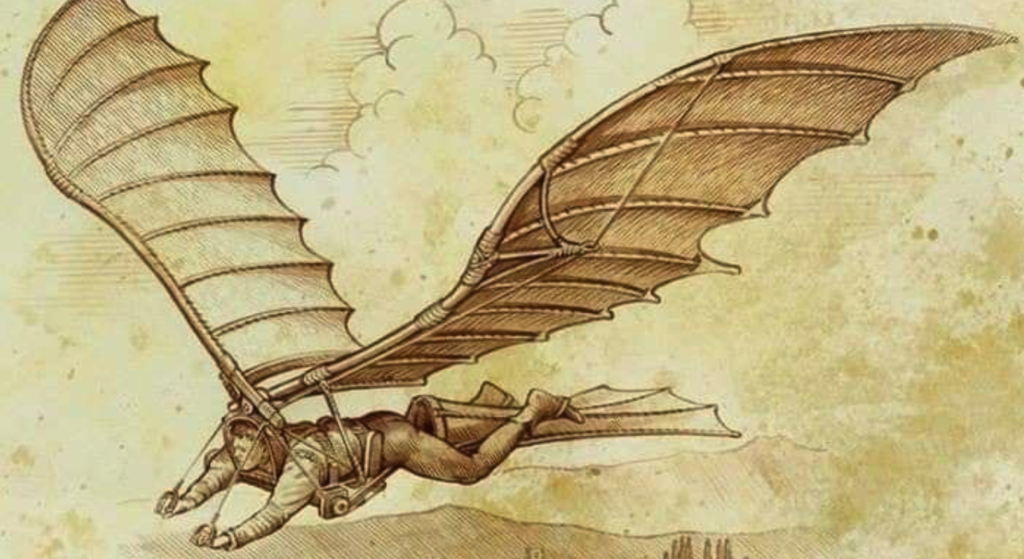
People watched birds soaring through the sky and thought they could do it too. That desire is ancient. For thousands of years, humans have strapped wings to their bodies and leaped from cliffs. Every attempt ended in failure. Yet each failure posed a new question: What killed them? From the blueprints of genius to hard-won scientific insight, centuries of human obsession are bound up in that single question.
The People Who Jumped from Cliffs
Since prehistoric times, humans have watched birds fly. They reasoned that if a creature with small muscles could take to the air, surely a larger, stronger human could do the same.
The logic was simple enough. Reality proved otherwise. Flight is not simple. Muscle, sinew, heart, breathing system, and intricate mechanisms like the flaps, variable-camber wings, and spoilers of modern aircraft all had to work in perfect harmony. But no one knew this.
So for thousands of years, countless people strapped on wings and jumped from cliffs. The names of those first bird-men are lost to history. But with each failure, one thing became clear: raw muscle alone is not enough to fly. Those failures posed a different question to the scientists and inventors of the next generation.
Leonardo da Vinci’s Notebook
In the 1500s, the Italian genius Leonardo da Vinci opened his notebooks. He sketched flying machines, page after page. Hundreds of designs accumulated.
But there was a critical flaw. He remained obsessed with flying “like a bird.” He imagined only one way to fly—by moving wings as a bird moves them. This design became known as the ornithopter. Despite being a brilliant anatomist, he missed the fundamental difference between a bird’s muscles and human muscles.
The sketches were beautiful and detailed. But they never left the ground. Even genius can be wrong. The more important question was this: Is the very premise correct? Must we fly as birds do?
Robert Hooke’s Sobering Truth
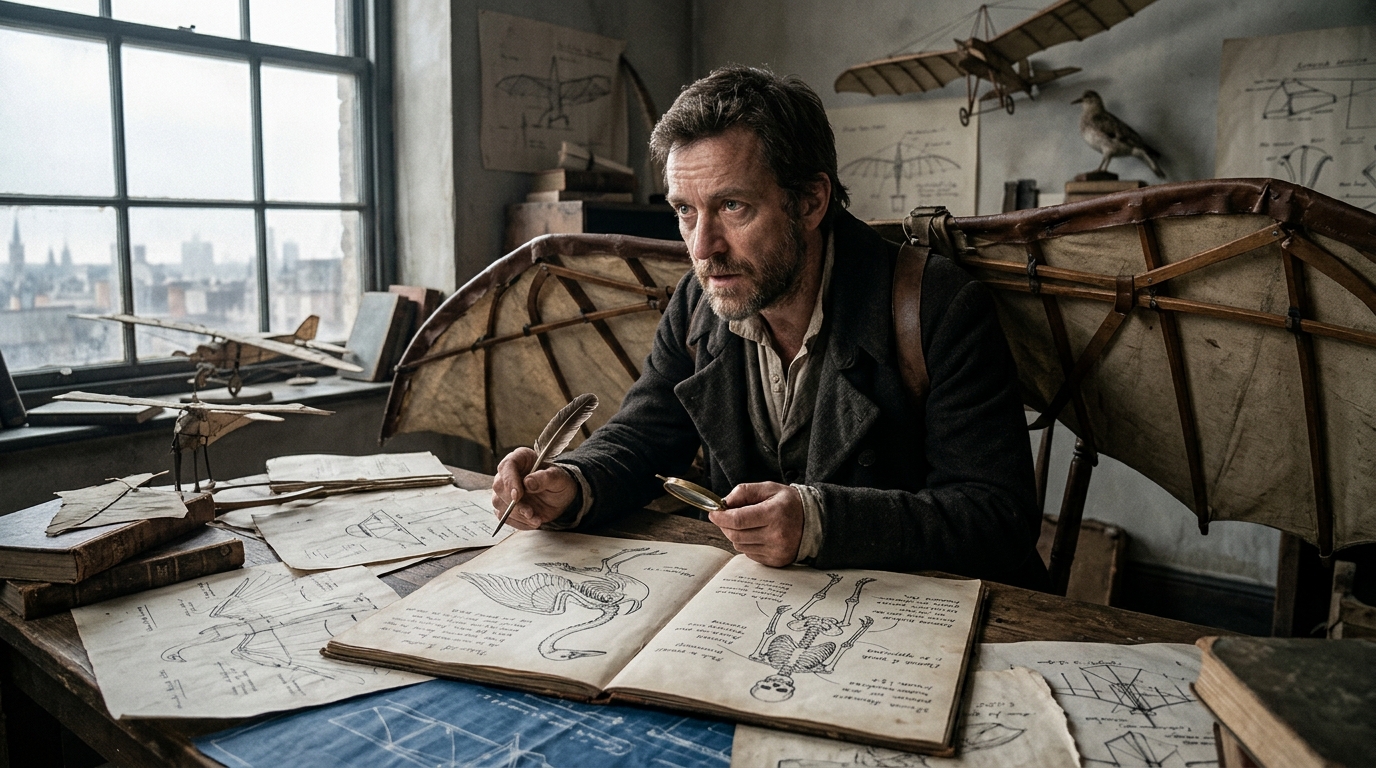
A century later, around 1655, an English mathematician and physicist named Robert Hooke offered a different answer.
“The human body does not possess muscles strong enough to operate artificial wings.”
It was discouraging but accurate. Hooke declared the impossibility of mimicking birds. Instead, he suggested an alternative: human flight would require “artificial propulsion.” It meant another way—not the way of birds.
The Balloon Conquers the Sky
In June 1783, something happened in France. A hot air balloon, crafted by brothers Joseph and Étienne Montgolfier, rose into the air. The first flight lasted 23 minutes. For the first time in human history, people lifted off the ground and touched the sky.
The men aboard were French noblemen Jean-François Pilâtre de Rozier and François Laurent d’Arlandes. The earth beneath them must have grown smaller and smaller.
Ten days later, French scientist Jacques Charles flew the first gas balloon—a vessel filled with hydrogen. Balloon fever swept across Europe. People flocked to witness the spectacle. Aviation enthusiasts now became drunk on the promise of “lighter-than-air” flight.
The Balloon’s Fatal Flaw
But balloons had a fundamental problem. You could go up. You could not control where you went.
Balloons were slaves to the wind. You could not steer. You could not choose your speed. To ride in a balloon was to be pushed wherever the winds of that altitude carried you. You had no say in the matter. You could not decide your destination.
They had achieved flight but not control. Balloons solved the problem of lift. But control remained unsolved. Flight required both. Someone had to solve the control problem.
A Hint from the Kite
Someone looked back into human history. To the kite—something China had flown for two thousand years.
A kite was simple. Paper or silk stretched over wooden frames. A child’s toy. But kites could do more than amuse. The Chinese flew them to watch for fires, to test winds before sailing, to send signals.
The key property of the kite was controllability. One string could change the angle of the wings. Unlike a balloon, a kite could be steered. By adjusting the angle, you could make it go where you wanted.
Someone noticed this principle. A kite could control the forces acting upon it in the air by changing its angle of inclination. What if you enlarged this principle—made it big enough to lift a person?

Sir George Cayley—”The Father of Aerial Navigation”
Sir George Cayley was born in England in 1773. He grew up watching the Montgolfier brothers’ balloon triumph in 1783. But Cayley’s attention turned not to balloons but to kites.
What if heavier things could fly? If you applied the principle of the kite, could something heavy be controlled in the air and made to fly? He spent 84 years of his life pursuing this question—proving that heavier-than-air flight was possible.
History would later call him the “Father of Aerial Navigation.” Cayley discovered the fundamental principles upon which modern aeronautics would be built. The angle of the wing. The center of gravity. Stability. But Cayley did not stop at theory.
Cayley’s Glider
Cayley decided to prove his ideas. In 1804, he built the first flying model. It worked. It actually flew. Without an engine, it stayed aloft. It could be controlled.
Cayley’s ambition did not end there. He wanted to build a glider large enough to carry a person. A glider is an aircraft with no engine, kept aloft purely by the aerodynamic properties of its wings. He wanted to prove that theory could become reality.
The result is a glider preserved in photographs from around 1852. It looks primitive now. But it was the first aircraft in human history to stay aloft without an engine. Someone had to fly it. It was dangerous. Cayley believed that someone had to be him—even as he entered his seventies.
How the Torch Was Passed
What Cayley left behind was more than a glider. He left proof that heavier objects could fly—without imitating birds, without becoming slaves to the wind like balloons.
Cayley died in 1857 at eighty-four. But thanks to the principles and proof he left behind, the inventors of the next generation could be certain of one thing: humans would fly.
Forty-six years later, on December 17, 1903, on a sandy beach at Kitty Hawk, North Carolina, the Wright brothers flew the Flyer. Twelve seconds. Thirty-seven meters. But it was the first flight of a powered aircraft.
The history of flight began not with “it’s impossible” but with the question “why is it impossible?” The people who fell from cliffs. The overconfidence of genius. The cold clarity of scientific insight. And a kite—a small hint. All of it converged in one man’s eighty-four-year pursuit. And finally, that pursuit breathed life into the machine of the next generation.
Leave a Reply