67 Dead: Why the Potomac Midair Collision Happened
AuthorTH Lee
PublishedMay 23, 2026
Read Time
48 min
Incident Date: January 29, 2025 Source: NTSB Official Investigation Report, FAA Public Statements
Executive Summary On January 29, 2025, at 8:47 p.m. Eastern time, a Bombardier CRJ-700 regional jet operated by PSA Airlines (branded as American Eagle Flight 5342) collided with a U.S. Army Sikorsky UH-60 Black Hawk helicopter over the Potomac River near Ronald Reagan Washington National Airport. All 67 people aboard—60 passengers, 4 crew members, and 3 Army helicopter crew members—perished in the crash. This represents the deadliest aviation accident in U.S. airspace in the 21st century and the first major midair collision between a commercial aircraft and a military helicopter since 1986. The NTSB investigation revealed this was not a single-point failure, but rather a catastrophic convergence of multiple system failures: fundamentally flawed helicopter route design, chaotic air traffic control operations, inadequate information sharing between military and civilian systems, and a critical altimeter error—all colliding simultaneously above the nation’s capital.
A Routine Flight, A Sudden End Departure: Wichita to Washington January 29, 2025. The Bombardier CRJ-700 departed from Dwight D. Eisenhower National Airport in Wichita, Kansas, heading eastward. Aboard were 60 passengers and 4 crew members—64 people bound for Ronald Reagan Washington National Airport (DCA). The flight was routine. The weather was clear. The crew was experienced. As evening approached and the aircraft descended toward the nation’s capital, no one aboard could have known this would be their final flight.
The Helicopter’s Training Flight U.S. Army Operations Near the Capitol At the same time, a UH-60L Black Hawk helicopter based at Fort Belvoir (near Arlington) was conducting a routine low-altitude training flight. The helicopter was flying at approximately 700-800 feet above the Potomac River. What the crew didn’t realize: their altimeter was lying to them.
8:47 PM: The Final Moments
Final Approach At approximately 8:45 p.m., the CRJ-700 captain received landing clearance from Washington Tower for Runway 33. The aircraft was on a standard descent profile at 1,400 feet, maintaining a normal descent rate of approximately 500-700 feet per minute. Distance to runway: approximately 3 nautical miles. The tower controller informed the pilot: “Traffic, helicopters in your vicinity.” The captain looked. But he saw nothing. The Altimeter Deception The Black Hawk crew faced a different situation. They were reading their barometric altimeter, which displayed their altitude as approximately 700 feet. But the actual altitude was different. The NTSB investigation discovered that the Black Hawk pilots may not have realized how high the helicopter was because the barometric altimeter they were relying on was reading 80 to 100 feet lower than the altitude registered by the flight data recorder. This 80-100 foot discrepancy would prove catastrophic. The CRJ-700’s descent path passed directly through 800 feet. The helicopter’s actual altitude: 800-900 feet. The collision point was determined by an instrument error measured in feet.
Chaos in the Tower The Washington control tower was operating at saturation. Multiple aircraft were preparing to land. Other aircraft were departing. Several helicopters were operating in the vicinity. The controllers were overwhelmed. When the tower informed both aircraft of each other’s presence, no explicit separation instruction was given. No command to “climb” or “descend.” Just notification: “Traffic in the area.”
8:47 PM: Collision The Impact Over the Potomac River, approximately 4 nautical miles southeast of Reagan National Airport, the two aircraft occupied the same airspace. The U.S. Army Sikorsky UH-60L Black Hawk helicopter and the Bombardier CRJ-700 collided over the river. The impact:
CRJ-700: Left engine destroyed, horizontal stabilizer severely damaged, flight control systems compromised, electrical systems partially disabled UH-60 Black Hawk: Main rotor severely damaged, tail rotor destroyed, immediate loss of control
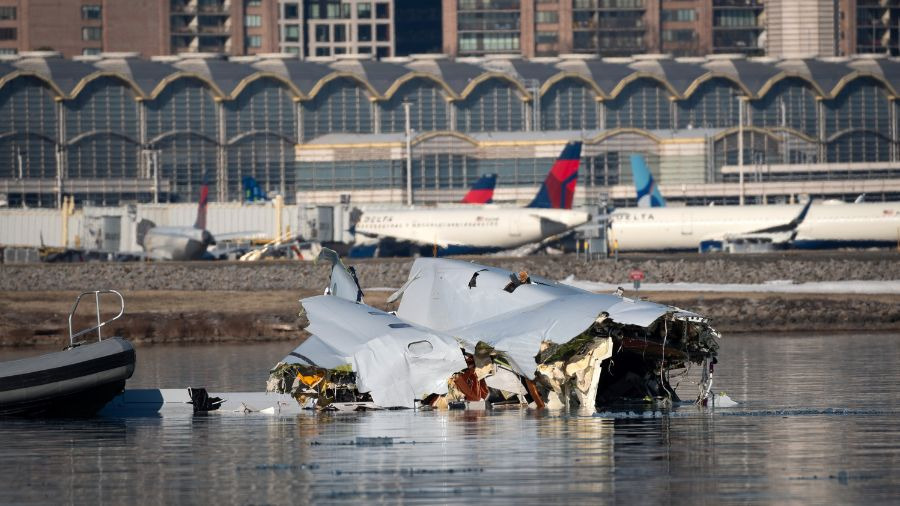
The Crash The CRJ-700 pitched sharply to the right after impact. The pilots fought to recover control. But the damage was too severe. The aircraft descended nearly vertically into the Potomac River. The Black Hawk, its rotor destroyed, crashed into the same river seconds later. Both aircraft broke apart in the cold January water.
NTSB Investigation: Systemic Failure Not a Single Cause The NTSB investigation did not identify a single cause for the collision on January 29, 2025. Instead, investigators placed the blame on multiple overlapping problems—including the location of a helicopter route in some of the nation’s most congested airspace, along with critical equipment failures and human errors. Jennifer Homendy, NTSB Chair, stated: “This complex and comprehensive one-year investigation identified serious and long-standing safety gaps in the airspace over our nation’s capital. Sadly, the conditions for this tragedy were in place long before the night of Jan. 29.” Root Cause #1: Fundamentally Flawed Helicopter Route Design The most critical problem: the helicopter route itself. The FAA had designed helicopter corridors in the Washington D.C. area. These corridors intersected with commercial aircraft approach and departure paths. More critically: there was no procedural separation between the helicopter route and the commercial aircraft path. No altitude separation requirement. No time separation rule. Nothing. Instead, the FAA relied on visual separation—pilots were expected to see each other and avoid collision. This is aviation’s most basic principle: “see and avoid.” Yet at 8:47 p.m., on a twilight evening, neither pilot could see the other aircraft in time. Root Cause #2: The Twilight Illusion Investigators showed recreated flight paths Tuesday using Microsoft Flight Simulator, modeling what the pilots of American Eagle Flight 5342 and the Army helicopter would have been able to see through the cockpit windshield. The helicopter pilots’ visual, while wearing night vision goggles, showed the bright lights of Washington in view, with the American regional flight in the background. This simulation revealed a critical problem: the CRJ-700 was virtually invisible against the dark sky, while the helicopter appeared as a small moving silhouette against Washington’s bright city lights. The time between visual acquisition and collision: less than 3 seconds. No pilot can execute an effective avoidance maneuver in 3 seconds—especially during landing approach when the aircraft is configured for descent. Root Cause #3: The Altimeter Error The NTSB has said the Black Hawk pilots may not have realized how high the helicopter was because the barometric altimeter they were relying on was reading 80 to 100 feet lower than the altitude registered by the flight data recorder. This error fundamentally changed the helicopter crew’s situational awareness. If the altimeter had been accurate, the crew might have:
Recognized the danger level of the approach Initiated a climb Been more alert to traffic warnings
Instead, they believed themselves to be at a “safe” altitude. They were wrong. Root Cause #4: Incomplete Air Traffic Control Communications Investigators also described a chaotic situation in the air traffic control tower and incomplete communications between the local controller and the helicopter pilots. The tower controller said: “Traffic, helicopters in your vicinity.” This is information, not instruction. The pilot received a warning but no guidance on how to respond. A more effective communication would have been:
“American Eagle 5342, helicopter 800 feet at your 2 o’clock, recommend climb to 1,500 feet” Or: “Black Hawk, traffic on your right, descend to 600 feet”
Instead, the controller provided awareness without actionable direction. Root Cause #5: Military-Civilian Aviation Integration Failure This refusal comes after an Army Black Hawk helicopter, without ADS-B activated, collided with an American Airlines regional jet on January 29, killing 67 people. While civilian aircraft must use ADS-B, the FAA granted the military an exemption in 2019. ADS-B (Automatic Dependent Surveillance-Broadcast) is the modern system that broadcasts aircraft position and altitude in real-time. The Black Hawk was not broadcasting ADS-B because of “national defense” considerations. Civilian aircraft must use it. Military aircraft had been exempted. Result: The CRJ-700’s collision avoidance system (TCAS) couldn’t “see” the helicopter clearly. Perhaps if ADS-B had been active, earlier detection might have provided critical seconds for avoidance.
Human Factors 1. Situational Awareness Loss The Black Hawk crew’s altimeter error destroyed their accurate perception of their position in space. They believed they were at a safe altitude. They were not. 2. Ambiguous Communications Controllers informed pilots of traffic but provided no specific avoidance instruction—leaving both pilots uncertain about what action to take. 3. Visual Separation Failure The fundamental principle “see and avoid” requires that both pilots must see each other early enough to take action. At twilight, over water, with city lights in the background, this failed. Technical Factors 1. Altimeter Malfunction An 80-100 foot error—less than the wingspan of some aircraft—became the difference between life and death. 2. TCAS System Limitations The CRJ-700’s collision avoidance system likely couldn’t provide sufficient warning due to the lack of ADS-B data from the helicopter and the extremely short reaction time available. 3. Radar Coverage Gaps Low-altitude radar coverage near terrain and water can be limited. The helicopter’s position may not have been as clearly visible to controllers as high-altitude aircraft. Organizational/Operational Factors 1. Absence of Procedural Separation No altitude separation requirement. No route separation. No time-based separation. Just hope that pilots would see each other. 2. Complex Airspace Management Washington D.C. airspace is among the most congested and complex in the United States. Helicopters, regional jets, major commercial aircraft, military planes—all operating under different procedures. 3. Military-Civilian System Integration Failure The Black Hawk was operating in civilian airspace but not fully integrated into civilian air traffic control procedures. Critical information gaps existed. Environmental Factors 1. Twilight (Civil Dusk) The worst possible time for visual separation—the sun has set, but ambient light remains. Depth perception is nearly impossible. Aircraft at different altitudes become indistinguishable. 2. Background Clutter City lights behind one aircraft make it nearly invisible against the dark sky. The aircraft becomes a silhouette lost in urban glow. 3. Mixed-Use Airspace Commercial, military, and civilian helicopters all sharing the same airspace, operating under different rules.
Shocking Discoveries During Investigation Night Vision Goggles: A False Sense of Security NTSB analysis revealed a critical limitation: night vision goggles, while helpful, create illusions of perception. They show motion clearly but poorly judge depth and distance. A rapidly approaching aircraft appears merely as a “moving dot” in a field of bright city lights. The CRJ-700, traveling at approximately 180 knots, closing on the helicopter position, would have appeared as an accelerating point of light—difficult to judge its speed or distance. Tower Overload NTSB voice tape analysis revealed the Washington control tower was operating under extreme stress. Multiple aircraft simultaneously preparing for approach/departure. Helicopter traffic. Ground traffic. One controller managing too many simultaneous events. Military ADS-B Exemption: The Policy Question The FAA has since mandated ADS-B use near Reagan National except for national security missions, and the NTSB will investigate whether the system’s activation could have prevented the crash. The exemption granted to military aircraft for “national security” reasons became a focal point of investigation. Would ADS-B activation have prevented this collision? Many aviation experts believe: yes.
NTSB’s 50 Safety Recommendations Primary Recommendation: Procedural Separation Stop relying on “see and avoid.” Implement mandatory altitude or route separation between helicopter corridors and commercial aircraft paths. This single change would have prevented this collision. Communication Clarity Controllers must provide specific, actionable instructions—not just warnings. Example: Instead of “Traffic in your vicinity,” say “Helicopter, climb to 1,500 feet” or “Recommend descent to 1,200 feet.” Altimeter Maintenance and Validation Strengthen inspection protocols for barometric altimeters. More frequent certification. Tighter tolerances. Mandatory ADS-B in Controlled Airspace Military aircraft operating in civilian airspace should activate ADS-B. National security and aviation safety are not mutually exclusive. Tower Modernization and Staffing Implement advanced automation systems. Increase controller staffing. Reduce per-controller workload. Integrated Training Military and civilian pilots should understand each other’s capabilities, limitations, and procedures. Cross-training and joint exercises are essential.
The ADS-B Controversy Defense Department Resistance Following the NTSB recommendations, the U.S. Department of Defense initially resisted mandatory ADS-B activation. Stated reason: “National security” Congressional Response Senators and aviation experts responded bluntly: “Is national security better served by allowing aircraft to collide, killing 67 people? Or by transmitting position data that will prevent midair collisions?” The logic was compelling. The Compromise The FAA has since mandated ADS-B use near Reagan National except for national security missions. Military aircraft can still disable ADS-B for genuine national security operations, but routine training flights and normal operations now require ADS-B activation. Helicopter Operations Suspension In the aftermath, the FAA temporarily suspended most helicopter operations near DCA. This suspension continues as of early 2026. Helicopter operations are now limited to emergency and essential military flights only.
What This Tragedy Teaches Us Lesson 1: “See and Avoid” Has Limits The fundamental principle of aviation safety—that pilots will visually detect conflicting traffic and avoid—does not work in all conditions. Low visibility, twilight, multiple aircraft types, complex airspace: “see and avoid” is insufficient. Procedural separation is mandatory. Lesson 2: Equipment Errors Can Be Catastrophic An 80-foot altimeter error. That’s all. One aircraft system malfunction. Sixty-seven lives lost. Maintenance, inspection, and validation protocols must be rigorous and frequently verified. Lesson 3: System Redundancy Is Non-Negotiable When the primary system (visual separation) fails, backup systems must exist. If the tower had provided explicit altitude guidance, could avoidance have occurred? We’ll never know. But the option didn’t exist. Lesson 4: Military-Civilian Aviation Integration Is Essential American airspace contains both military and civilian aircraft. Operational integration—not separation—is required. Different procedures, incomplete information sharing, and exemptions create dangerous gaps. Lesson 5: “National Security” Cannot Trump Aviation Safety Military exemptions from ADS-B for “national security” contributed to this collision. True national security is measured in safe citizens. An aircraft falling from the sky killing 67 people is a security failure, not a security victory.
The Victims Passengers and Crew 60 passengers. 4 crew members. People who boarded expecting to arrive safely in Washington, D.C. Army Helicopter Crew 3 Army aviation personnel. Professionals serving their country. Common Thread All 67 died not from individual error, but from system failure. They died because the system designed to prevent such collisions had fundamental flaws.
Conclusion: American Aviation Safety Reckoning Investigators placed the blame on multiple overlapping problems—including the location of a helicopter route in some of the nation’s most congested airspace, along with critical equipment failures and human errors. The tragedy over the Potomac forced American aviation to confront uncomfortable truths:
Procedures matter more than hope — Stop hoping pilots will see each other. Mandate separation. Equipment must be verified relentlessly — 80 feet can be catastrophic. System integration is non-negotiable — Military and civilian aviation must operate under unified safety principles. Staffing and workload affect safety — Overtaxed controllers cannot protect anyone. Modern technology must be deployed — ADS-B works. Use it.
The NTSB’s 50 recommendations represent America’s commitment to ensuring this specific tragedy never repeats. But will other recommendations be ignored? History suggests some will be—aviation safety always competes with cost, convenience, and bureaucracy. The families of the 67 victims know this. They are watching.
Incident Statistics ItemDetails
Date & Time January 29, 2025, 8:47 p.m. Eastern Time
Location Potomac River, ~4 nautical miles from DCA
Aircraft Altitude at Impact 1,400 feet (planned descent profile)
Helicopter Actual Altitude 800-900 feet
Altimeter Error 80-100 feet (displayed lower)
Total Fatalities 67
Survivors 0
Official Sources Investigation Authority:
NTSB Accident Investigation (Case: DCA25MA040) Final Report: January 2026
Public Statements:
FAA Emergency Notices U.S. Department of Defense Statement Army Aviation Command Response Congressional Testimony
Safety Materials:
NTSB 50 Safety Recommendations (January 2026) FAA Airworthiness Directives Procedural updates to Washington Class B airspace
Important Note The D.C. plane crash was the first in a number of high-profile crashes and close calls throughout 2025 that alarmed the public, but the total number of crashes last year was actually the lowest since the COVID-19 pandemic hit in 2020 with 1,405 crashes nationwide. Experts say flying remains the safest way to travel because of all the overlapping layers of precautions built into the system, but too many of those safety measures failed at the same time last Jan. Despite this tragedy—or because of it—aviation safety systems continue to evolve and improve.
A Reminder for Every Flight When you board your next aircraft, remember: Your safety is built on regulations, procedures, investigations, and continuous improvement. It is built on lessons learned from tragedies. It is built on 67 lives lost over the Potomac River on a winter evening in 2025. Never forget that safety is purchased in tragedy.
This post honors the memory of the 67 people lost on January 29, 2025. Based on official NTSB investigation findings and FAA public records Last updated: January 2026


Leave a Reply