
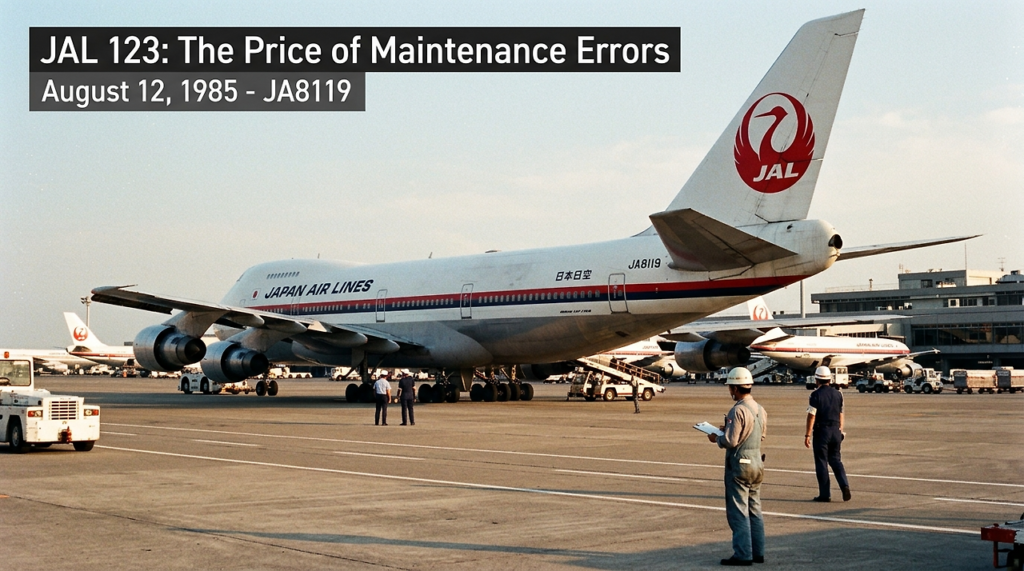
The Tragedy of August 12, 1985
On August 12, 1985, at 6:12 PM, a Boeing 747SR departed from Tokyo’s Haneda Airport bound for Osaka. It was Japan Airlines Flight 123 (JAL 123). Of the 524 people on board—509 passengers and 15 crew members—520 would perish. It remains the deadliest single-aircraft accident in commercial aviation history. The cause: a maintenance repair done seven years earlier that was fundamentally flawed.
You’ve likely seen aircraft maintenance technicians working on runways: inspecting components with tools, examining panels, recording data meticulously. Each small inspection protects the lives of everyone aboard. JAL 123 is a stark reminder of how catastrophic it becomes when that process fails—and how far the ripples of that failure extend.
Complete Loss of Control: 12 Minutes Into Flight
Captain Masami Takahama, a highly experienced training captain with 12,400 flight hours, held overall command. First Officer Yutaka Sasaki, with 3,963 flight hours, occupied the left seat for training as captain. Flight Engineer Hiroshi Fukuda, a veteran of 9,831 flight hours, completed the cockpit crew.
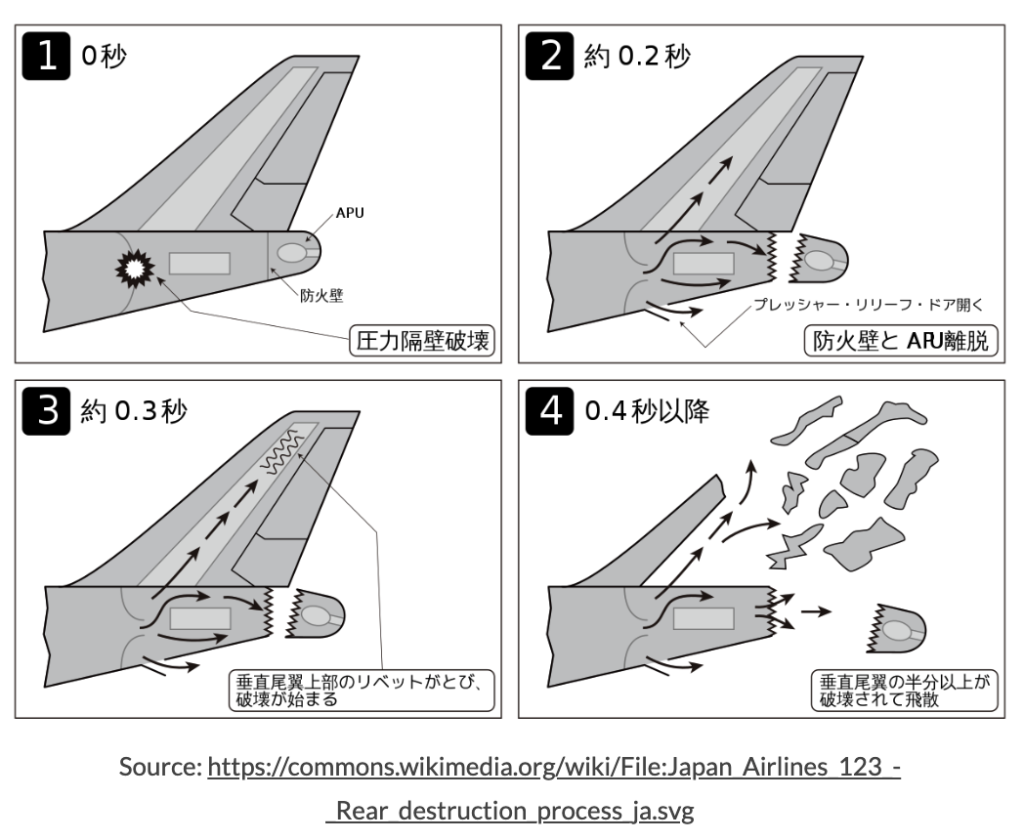
Twelve minutes after takeoff, as the aircraft approached its cruising altitude of 24,000 feet, a violent explosion shook the cabin. Warning lights illuminated across the flight deck. The rear pressure bulkhead—a critical structural component separating the pressurized cabin from the unpressurized tail section—had ruptured catastrophically.
The explosion caused explosive decompression. The pressure surge damaged the Auxiliary Power Unit (APU), the rudder, and a large section of the vertical stabilizer. Most critically: all four hydraulic lines were severed. Aircraft are controlled entirely through hydraulic pressure. With zero hydraulic pressure, the aircraft became immediately uncontrollable.
Captain Takahama radioed in disbelief: “All hydraulic pressure is lost. Pressure is zero.”
For the next 32 minutes, the crew attempted an extraordinary maneuver: using only engine thrust, they varied the rotation speed of the four turbofan engines to influence the aircraft’s direction—a technique that barely worked and required constant, exhausting corrections. The aircraft entered a violent oscillation known as “Dutch roll,” rolling into banks as steep as 60 degrees and pitching into dives reaching 18,000 feet per minute.
At 6:56 PM, JAL 123 descended through 1,600 meters and struck Mount Takamagahara (also called Mount Osutaka) in Gunma Prefecture. The aircraft struck the mountain at approximately 340 knots (631 kilometers per hour), then impacted a second time at a lower elevation. The aircraft was completely destroyed. Only four survivors were found, all near the tail section that had separated during impact.
The Root Cause: A Tail Strike Repair From June 2, 1978
Investigators combed through the wreckage. The source of the catastrophe lay in the aft pressure bulkhead—the very component that had ruptured.
More than seven years earlier, on June 2, 1978, this same aircraft (registration JA8119) experienced a severe tail strike during landing at Osaka International Airport while operating as Japan Airlines Flight 115. The aircraft bounced heavily on landing, and its tail section struck the runway. At the time, the aircraft carried 12,300 pressurization cycles and 16,200 flight hours. The impact caused substantial damage to the aft fuselage frames, skin, and the aft pressure bulkhead. Twenty-five passengers were injured.
Japan Airlines contracted with a Boeing Airplane-On-Ground (AOG) team to repair the damage. The repair procedure required installing a double row of rivets to properly secure the repaired bulkhead, according to Boeing’s maintenance manual. However, the Boeing repair team deviated from the specification—they installed only a single row of rivets, significantly reducing the structural strength of the repair. The investigation later concluded that this incorrect installation reduced the part’s resistance to metal fatigue by approximately 70%.
Between the 1978 repair and the 1985 accident, the aircraft completed 12,319 takeoffs. Boeing engineers calculated that the improper repair would have failed after approximately 10,000 pressurization cycles. The aircraft exceeded that threshold. Each cycle imposed cyclical stress on the already-weakened bulkhead. Metal fatigue progressed silently—imperceptibly at first, then relentlessly.
The bulkhead had accumulated damage over seven years of short-haul operations between Tokyo and Osaka, two of Japan’s busiest routes. The welded area that should have grown stronger through correct repairs instead grew progressively weaker. Stress cracks initiated in the fatigue zone and propagated gradually. No inspection method in use at the time detected these microscopic internal fractures.
On August 12, 1985—the aircraft’s 12,319th flight after the faulty repair—the accumulated fatigue reached a critical threshold. During flight, the pressure differential between the pressurized cabin and the unpressurized tail section created a stress load on the weakened bulkhead. The structure failed explosively.
The Blind Spot in Maintenance Procedures
At the time, Japan Airlines followed international standards meticulously, conducting monthly, quarterly, and annual scheduled maintenance inspections. All procedures were performed according to published standards. However, a critical gap existed in those standards.
Ultrasonic and X-ray inspection equipment could detect internal cracks—but these technologies were expensive and required manual operation. As a result, the standard inspection practice worldwide was to identify only visible damage to aircraft structure. Technicians felt surfaces with their fingers, examined them visually, and listened for irregularities by tapping. But microscopic cracks inside the metal remained invisible.
An expert from Japan’s aircraft safety investigation later reflected: “Maintenance technicians felt the surfaces with their fingers, inspected them with their eyes, and listened for irregularities with tapping. But metal fatigue cracks inside the material—those are invisible to these methods.”
More fundamentally, inspectors had no reason to suspect the 1978 repair was substandard. The damaged area showed no external evidence of failure. The repair appeared complete. It was not the practice to re-inspect historical repair areas with advanced techniques unless obvious problems emerged. A maintenance error from years ago, accepted as resolved, remained hidden.
The aft pressure bulkhead operated under enormous cyclical stress during every pressurization/depressurization cycle. The repair that should have restored the structure to full strength had instead created a time bomb—one that would tick for 12,319 flights before detonating.
How the Aviation Industry Transformed
The investigation into JAL 123 shocked the global aviation community. The conclusion was inescapable: a single deviation from repair specifications, committed seven years earlier by a repair team, killed 520 people. Yet from that tragedy emerged sweeping reforms that would save countless lives.
Beginning immediately after JAL 123, the aviation industry implemented three major changes that became global standards:
Ultrasonic and X-ray inspections became mandatory. Periodic inspections began including advanced non-destructive testing. Areas with previous damage history became high-priority inspection points, subject to enhanced scrutiny and more frequent re-examination. No longer would a past repair be simply marked “complete” and forgotten.
Defect reporting systems were strengthened dramatically. Every maintenance discrepancy, no matter how minor, was now formally documented and entered into a tracking system. Small damage that might have been overlooked before became part of a permanent record that could reveal patterns.
Computer-based maintenance management systems replaced paper records. Airlines implemented databases where every maintenance action was logged, every component’s inspection interval tracked, and every scheduled replacement date automatically calculated. These systems flagged when a component or area was approaching its inspection cycle, eliminating the possibility of oversight.
These reforms rippled throughout the global aviation industry—adopted by airlines worldwide, mandated by regulatory authorities, and incorporated into international aviation standards. The tragedy transformed maintenance from a procedural checklist into an data-driven discipline with redundancy and transparency built in at every level.
The Weight of Precision in Maintenance
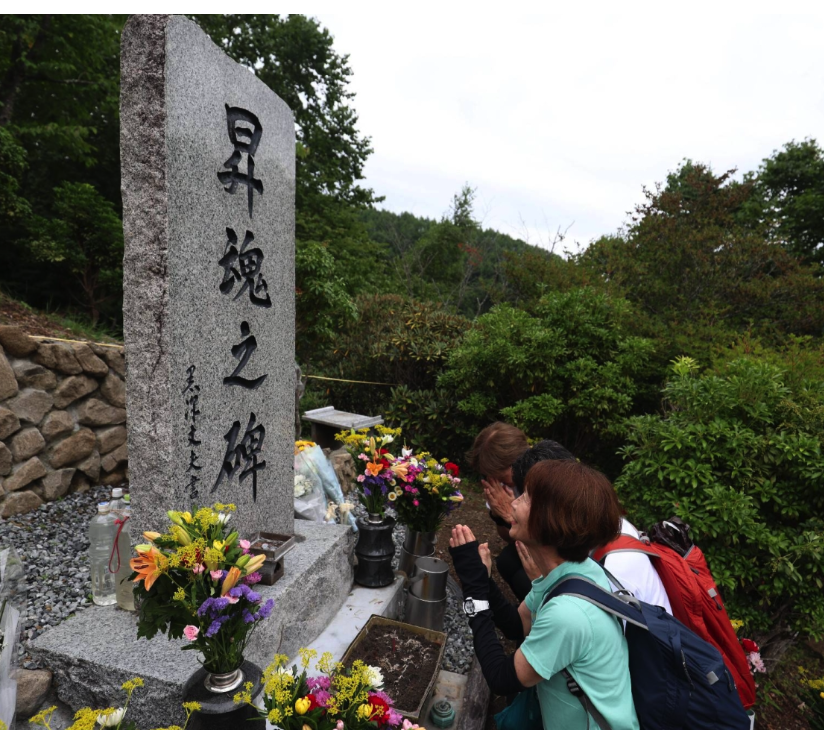
Almost 40 years have passed since August 12, 1985. The aircraft that crashed is long gone. Captain Takahama, First Officer Sasaki, and Flight Engineer Fukuda are all deceased. The four survivors have lived with the weight of that day their entire lives.
But something changed in aviation that day. One maintenance error—a decision made in a repair facility in 1978 to use one row of rivets instead of two—killed 520 people. Yet through the transformed standards that emerged from that investigation, billions of passengers have since flown safely across decades of aviation history.
Every technician on a runway, every data point entered into a maintenance database, every advanced inspection scan conducted—all of these practices exist because of what we learned from JAL 123. The rigorous documentation, the non-destructive testing, the permanent defect records, the computer tracking systems—none of these were standard before. They were forged in the aftermath of a catastrophe.
Aircraft are built by maintenance. They are kept safe by precision, by documentation, by relentless attention to every detail—no matter how small it seems in the moment. JAL 123 proved that a single hidden flaw, left undetected for seven years across 12,319 flights, can unravel everything. It also proved that when we respond to that failure with systemic change, we save millions of lives.
Verified Sources:
NTSB records, FAA investigation data, JTSB (Japan Transport Safety Board) official accident investigation report, manufacturer repair specifications, cockpit voice recorder transcript.
Leave a Reply