
Why the Hot Air Balloon Was Only “Half” a Flight As we saw in the last chapter, the Montgolfier brothers’ hot air balloon in 1783 achieved humanity’s oldest dream. Just being up in the sky was enough for that era. But balloon pilots soon faced a problem: even after flying for 15 minutes, they couldn’t control their direction. They drifted wherever the wind carried them. Floating in the sky and actually controlling the sky turned out to be two completely different challenges.
Cayley’s answer, found in the kite, was clear: you needed kite-shaped wings. But knowing the answer didn’t mean a working airplane would simply materialize. For nearly 100 years after Cayley, hundreds of scientists and inventors worked to turn that answer into reality. And the ones who succeeded were, exactly, two bicycle mechanics.Lilienthal: The Man Who Jumped Off a Hill To tell the story of the Wright Brothers’ success, we first need to know Otto Lilienthal.
The German engineer Lilienthal
The German engineer Lilienthal threw himself off hills near Berlin—off Stölln mountain, about 100 feet high—between 1891 and 1896, piloting a glider. Every jump was a brush with death. There was no engine. He wore a frame with wings he could control with both arms and ran down the hillside, feeling the air currents, shifting his body weight to steer.
He looked something like a modern hang glider pilot, but Lilienthal’s flying was far more dangerous. Today’s hang gliders study angles, speeds, and altitudes, learning tested layouts. Lilienthal had no data—he learned with his body.
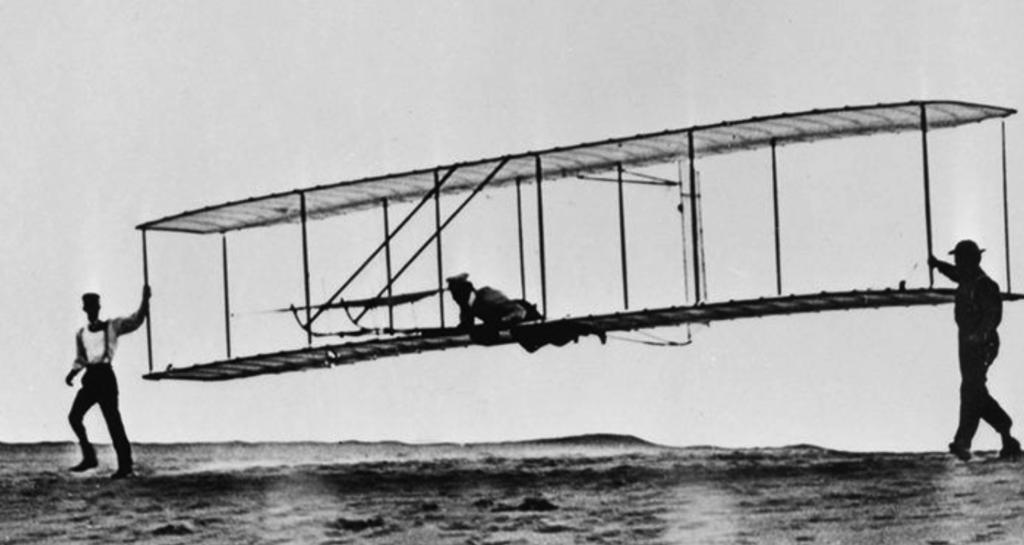
Still, Lilienthal flew his glider about 2,000 times and proved he could stay airborne for 5 to 30 seconds at a time. His longest glide covered roughly 820 feet. Here’s what mattered most: he actually demonstrated that unpowered flight was possible. Not theory—fact.
In August 1896, Lilienthal crashed on one flight, broke his spine, and died two days later. He was 47. But what he left behind was enormous: glider blueprints, flight records, and most important—proof that “humans can fly.”
Why Bicycle Mechanics?
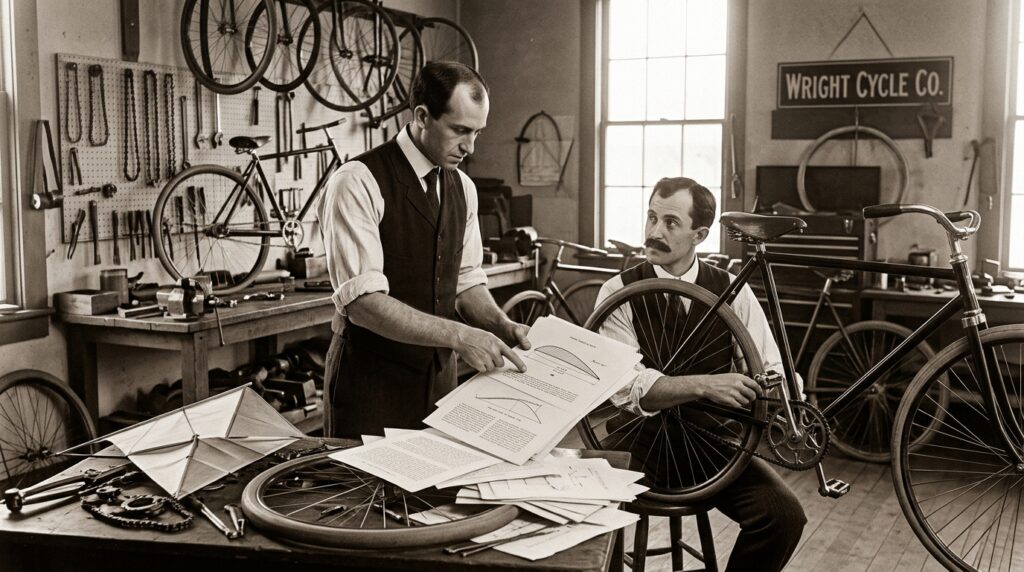
The Wright Brothers’ Identity and What Drove Them to AviationA bicycle shop in Dayton, Ohio. Wilbur (born 1867) and Orville (born 1871) Wright repaired and modified bicycles there. Why, of all people, would bicycle mechanics build an airplane?
It was no accident. In the 1890s, the bicycle was America’s cutting-edge piece of mechanical engineering: chains, gears, bearings, steel frames—the bicycle was a pocket-sized example of precision engineering. Running a bicycle shop meant more than selling parts. You had to deeply understand mechanics and materials.
The turning point came in 1899. Wilbur wrote to the Smithsonian Institution asking for books and papers on aviation. They sent him Lilienthal’s papers and experimental records. The two brothers looked at Lilienthal’s glider design and realized something: this is missing data.
If Lilienthal flew by intuition and experience, the Wright brothers chose a different path: mathematics, physics, measurement—the scientific method. It was a revolutionary strategy for a couple of bicycle technicians.Four Years in a Science Lab: Building Data With Kites, Wind Tunnels, and Engines1899 to 1903. Exactly four years.
The Wright brothers started with kites
The Wright brothers started with kites. They wanted to find what Lilienthal had missed. Through kite experiments, they discovered something crucial: you had to precisely measure how a wing receives air flow. Specifically, they realized how critical the angle of attack—the angle a wing makes with the air—really was.
Next came the wind tunnel.The Homemade Wind Tunnel — What Makes It Different From a FanIn the winter of 1901, the Wright brothers built something in their bicycle shop: a box. About 6 feet long, 16 inches by 16 inches square in cross-section. A small engine at one end blew air through it. The design kept the air flowing through the box at a constant speed.
What’s the difference from a modern fan? A fan “shakes” air to create a breeze. Turn on a fan in a room and you get wind, but the speed varies with time and location. A wind tunnel is different. The air passing through maintains an almost perfectly constant speed. It becomes a controlled laboratory environment.
The Wright brothers placed small wing models (about 6 inches) inside this tunnel and measured them. At different angles, different shapes, different speeds. They recorded the lift force and drag force using mechanical scales.
In an era without equations, there was only one way to gather data: repeat experiments directly. They tested roughly 200 different wing shapes. For each one, they precisely recorded the ratio of lift to drag. They discovered that the wing design used in Lilienthal’s glider had a poor lift-to-drag ratio.
This is the power of the scientific method: you can know about failures before they happen. The Wright brothers’ wind tunnel work from 1901–1902 provided aviation’s first reliable collection of data.Kitty Hawk, December 17, 1903 — Following the Morning on the Day ItselfKitty Hawk, North Carolina. Why this location? The biggest reason was wind. Kitty Hawk, on the Atlantic coast, was known to have steady winter winds. And the beach. If you crashed in a field or on rocks, it was dangerous. But sand absorbs some of the impact. That was practical calculation.
That December 17th morning, the temperature was 36°F (about 2°C). Wind speed was around 21–27 mph (about 33–43 km/h). Pretty strong winds.
The Wright brothers’ “Flyer” looked odd for an airplane. It had two wings (biplane), and the frame was made of wood and steel wire, like a bicycle. It weighed about 50 pounds—less than half an adult’s weight. The engine was a 4-horsepower gasoline engine—about as powerful as a modern lawnmower.
three-axis control
The Wright brothers invented “three-axis control”:Pitch control — nose up and down: they moved the front wing. It worked like the elevator on a modern plane.Roll control — tilting left and right: they twisted the rear wings (wing warping) so one side could generate more lift. It worked like an airplane’s ailerons.Yaw control — nose left and right: they used a rear vertical wing. Just like a modern plane’s rudder.Without all three axes, a plane can’t fly stably. Even a slight wind gust and it crashes. This three-axis control was the key discovery the Wrights made.
Wilbur and Orville flipped a coin to decide who would go first. Orville won and became the first pilot.
Around 10:35 a.m., the Flyer lifted off.The 98 Seconds and 4 Flights — Breaking Down the Numbers
First flight: Orville piloting
– Time: 12 seconds
– Distance: about 120 feet (37 meters)—shorter than an American football field
– Altitude: maximum about 10 feet (3 meters)
Second flight: Wilbur piloting
– Time: 15 seconds
– Distance: about 175 feet (53 meters)
– Altitude: about 10 feet (3 meters)
Third flight: Orville piloting
– Time: 20 seconds
– Distance: about 200 feet (62 meters)
– Altitude: about 10 feet (3 meters)
Fourth flight: Wilbur piloting
– Time: 59 seconds—the longest of the total 98 seconds
– Distance: about 852 feet (260 meters)
– Altitude: about 10 feet (3 meters)
All four flights together lasted 98 seconds. That’s the same as making a one-minute video on a modern smartphone. Yet that video changed history.
The most remarkable detail is the distance. Flying 260 meters on the fourth flight meant they could maintain a steady speed and control. There was stability even when wind gusts came. This wasn’t just gliding down—this was actual level flight.
Each flight ended not with a landing but a “touchdown.” There were no wheels or axles. A skate-like structure under the frame touched the sand and stopped it.”Build and See” vs. “Know and Build” — The Real Reason the Wright Brothers SucceededBefore the Wright brothers, many people tried to build airplanes. Most followed this approach:Build giant wings.Attach an engine.Try to fly.Crash.Attach a bigger engine.Repeat.This is trial-and-error. Many famous flight attempts in history used exactly this method. Lilienthal, in some ways, depended on it too. There was no scientific data.
The Wright brothers were different.
The Wright brothers were different.Understand the principles of lift—wind tunnel experiments.Find a way to control stably—design three-axis control.Build an efficient engine—design and make it themselves.Design a light frame—apply bicycle engineering.Then try to fly.Every part had answers to “why” and “how.” When they failed, they knew which part was the problem.
The Wright brothers succeeded not because they had bigger budgets or better teams. They succeeded because they used the scientific method.
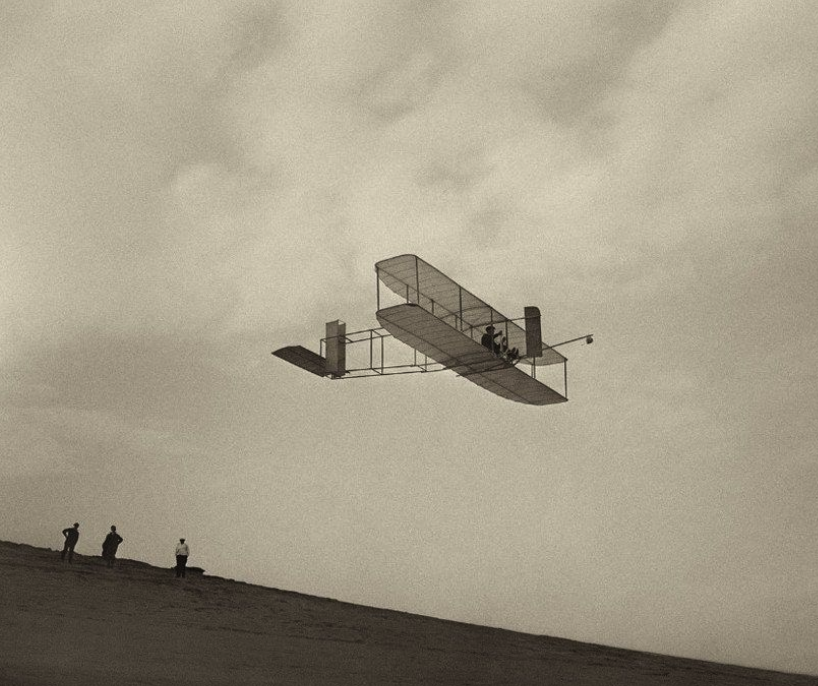
They built and tested a glider by 1902. Using wind tunnel data, they designed a glider and flew it about 1,000 times. They collected data from each flight and fed it back into the next design. The powered flight of 1903 was the accumulated result of four years of work.How Does This 98-Second Flight Connect to the Airplane I Fly Today?Imagine boarding a modern airliner. When a Boeing 737 or Airbus A320 takes off, the discovery of the Wright brothers is alive inside it.
First: the principle of three-axis control
Move a modern plane’s control yoke forward and back, and the pitch changes. Turn it left and right, and the roll changes. Push the foot pedals, and the yaw changes. The exact same three axes the Wrights invented in 1903. A hundred years later, the basic control system is fundamentally unchanged.
Second: the wind tunnel design approach
When Boeing or Airbus develops a new aircraft, the first thing they do is wind tunnel testing. Just like the Wright brothers. Except today’s wind tunnels are massive (they can create winds over 186 mph) and run alongside computer simulation. But the basic principle is the same as their 6-foot-long box: “Collect data in a controlled environment.”
Third: lightweight design
The Flyer weighed 50 pounds. The heavier something is, the bigger the engine needed, the more fuel required. Modern airliners weigh hundreds of tons, but they’re packed with lightweight materials and design philosophy: aluminum alloys, carbon fiber, optimization of every part—all descended from the Wright brothers’ principle of “lighter, more efficient.”
Flight stability and precise control, fuel efficiency. All built on principles that came from 98 seconds in the air.Scientific Thinking Reignites a Dream That Was FadingThe Wright brothers released very little information publicly. By then, the U.S. government and other nations recognized the military value of the airplane, and patent disputes were common. The Wrights were reluctant to share their technology.
So the progress that followed—aviation advances in other countries—didn’t just “copy” the Wright brothers’ invention. Instead, these countries followed their “scientific method” and developed aviation independently. When Louis Blériot of France crossed the English Channel, when Anthony Fokker of Germany built a monoplane, both went through wind tunnel testing and data-driven design.
The Wright brothers’ greatest gift wasn’t their patent or the airplane itself. It was the methodology—”this is how to do it.” It showed how science and engineering come together.The Core of This ChapterIf Lilienthal showed that unpowered flight was possible, the Wright brothers discovered the principles through wind tunnel experiments and data.
The success of two bicycle mechanics wasn’t about bigger budgets or better technicians. It was because they used the scientific method instead of trial-and-error.
Today’s airplane control principles, design approaches, and lightweight philosophy all began with those 98 seconds in 1903.Next Chapter PreviewThe airplane can now fly. But not just anyone could freely take to the skies. In the next chapter, we follow the history of how the U.S. government began managing the airplane, and why you see “FAA approved” markings every time you fly. How did regulation make flying safer?
Leave a Reply