

The Core of Aeronautical Decision-Making: Effective Aviation Risk Management Strategies
In aviation, safety is the paramount value. Aeronautical Decision-Making (ADM), which helps pilots make correct decisions during flight, is crucial. Specifically, Aviation Risk Management is a core component of ADM. Its purpose is to proactively identify potential hazards and minimize the risks they pose. This article will delve into what aviation risk management entails and how it can be effectively implemented.
Aviation Risk Management: Its Essence and Importance
Aviation Risk Management is the process of identifying hazards related to flight safety and mitigating those risks. When pilots follow sound decision-making practices, inherent flight risks can be significantly reduced or minimized. Excellent decision-making skills are developed through direct and indirect experience and education.
Aviation risk management is closely linked not only to the individual pilot’s capabilities but also to the organizational Safety Management System (SMS). SMS is a comprehensive approach that includes safety policy development, risk management, safety assurance, and safety promotion. Therefore, effective aviation safety is achieved through the systematic efforts of both individuals and organizations.
The 6-Step Process of Risk Management Decision-Making
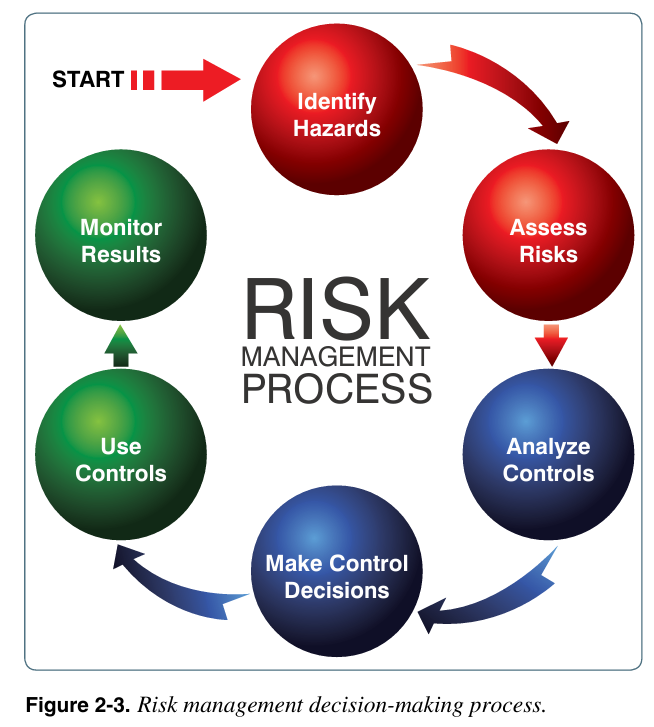
Risk management requires a systematic approach. An effective risk management decision-making process includes the following six steps:
- Hazard Identification: Identify conditions, events,
or situations that could lead to potential risks. - Risk Assessment: Analyze the severity of the
potential impact that identified hazards might have. - Control Analysis: Review possible control measures
to reduce or eliminate risks. - Control Decision: Select the most effective and
practical control measures from those analyzed. - Control Implementation: Apply the chosen control
measures to actively manage the risk. - Monitoring Results: Continuously monitor the
effectiveness of the control measures and adjust as necessary. >
The 4 Core Principles of Aviation Risk Management
Pilots must always keep the following four fundamental principles in mind for effective aviation risk management:
- Do Not Accept Unnecessary Risk: While flying
inherently involves risk, unnecessary risks that offer no commensurate
benefit must be avoided. For instance, flying an unfamiliar aircraft in
low visibility conditions is an unnecessary risk. - The Pilot Makes Risk Decisions: Risk decisions must
be made by individuals capable of developing and implementing risk
control measures. As the Pilot-in-Command, the pilot holds ultimate
responsibility for all flight-related risk decisions. - Accept Risk When Benefits Outweigh Costs: Some
level of risk acceptance is essential for any flight activity. For
example, flying an familiar aircraft in optimal weather conditions for a
critical mission represents a reasonable acceptance of risk, as the
potential benefits far outweigh the risks. - Integrate Risk Management at All Planning Stages:
Risk is an unavoidable part of every flight. Risk management is
necessary not only during pre-flight planning but also throughout all
phases of the flight.
Clear Distinction Between Risk and Hazard
Two important elements of Aeronautical Decision-Making (ADM) are Hazard and Risk. A Hazard refers to the actual or perceived condition, event, or environment that a pilot faces. Risk, on the other hand, is an evaluation of the potential impact these hazards could have on the pilot.
For example, imagine a small scratch is found on an aircraft propeller. This scratch itself is the hazard. The risk here is the possibility of the propeller failing during flight due to the scratch. An experienced pilot might determine the risk is low if the scratch is located on a strong part of the propeller, distributing stress. In contrast, an inexperienced pilot might assess the risk as high and cancel the flight, given the information that propeller damage could lead to catastrophic failure. Thus, the risk assessment for a hazard can vary depending on an individual’s experience and knowledge.
Beyond a pilot’s physical condition and experience, attitude significantly impacts the quality of decision-making. Attitude, defined as a motivational predisposition to respond to certain situations or events, is a critical factor. Research indicates there are five hazardous attitudes that impede sound decision-making.
5 Hazardous Attitudes and Antidotes That Threaten Pilot Safety
The following five hazardous attitudes can undermine pilot safety. It is crucial to recognize each attitude and apply the appropriate antidote:
- Anti-authority: “Don’t tell me what to do.” This
attitude views rules and regulations as unnecessary.- Antidote: “Follow the rules. They are usually
right.”
- Antidote: “Follow the rules. They are usually
- Impulsivity: “Do it quickly!” This attitude
involves acting on impulse without thinking.- Antidote: “Not so fast. Think first.”
- Invulnerability: “It won’t happen to me.” This
attitude believes accidents only happen to others.- Antidote: “It could happen to me.”
- Macho: “I can do it!” This attitude involves
overconfidence in one’s abilities and taking unnecessary risks.- Antidote: “Taking chances is foolish. Safety comes
first.”
- Antidote: “Taking chances is foolish. Safety comes
- Resignation: “What’s the use?” This attitude
believes one’s actions have little impact on outcomes.- Antidote: “I am not helpless. I can make a
difference.”
- Antidote: “I am not helpless. I can make a

Utilizing the Risk Assessment Matrix and Specific Examples
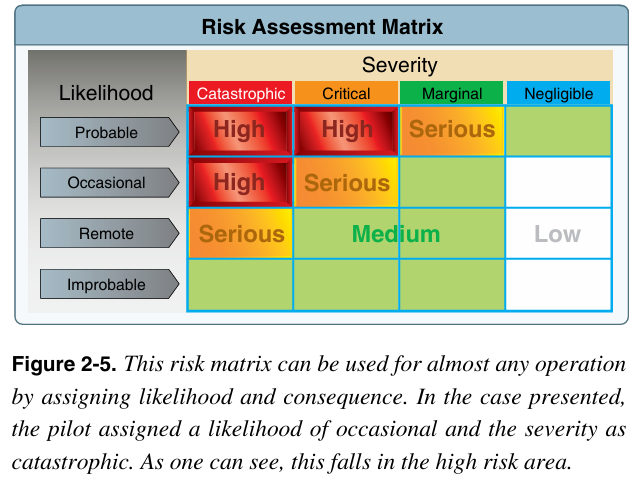
To evaluate the degree of risk and determine the optimal course of action, pilots can utilize a risk assessment matrix. This matrix helps visualize risk levels based on Likelihood and Severity of consequences.
Likelihood classifications are as follows: * Frequent: Almost certain to occur. * Probable: Likely to occur repeatedly. * Occasional: Likely to occur sometimes. * Remote: Unlikely to occur, but possible. * Improbable: Highly unlikely to occur.
Severity classifications are as follows: * Catastrophic: Multiple fatalities, hull loss. * Hazardous: Serious injury, aircraft damage. * Major: Minor injury, minor aircraft damage. * Minor: Minimal injury, negligible aircraft damage. * Negligible: No impact.
For example, if a specific hazard has an ‘Occasional’ likelihood and ‘Catastrophic’ consequences, it falls into a high-risk area. Pilots can objectively assess risks and develop appropriate countermeasures using these specific criteria.
Conclusion: In aviation, Aviation Risk Management is more than just a procedure; it is an essential mindset for safe flight. The systematic process of accurately identifying hazards, objectively assessing risks, and establishing and implementing appropriate control strategies is central to a pilot’s proficiency. Furthermore, recognizing and managing one’s own attitudes plays a decisive role in making wise decisions in hazardous situations. Through continuous learning and training, pilots can ensure safety and achieve successful flights even in unpredictable aviation environments.
Leave a Reply