Executive Summary
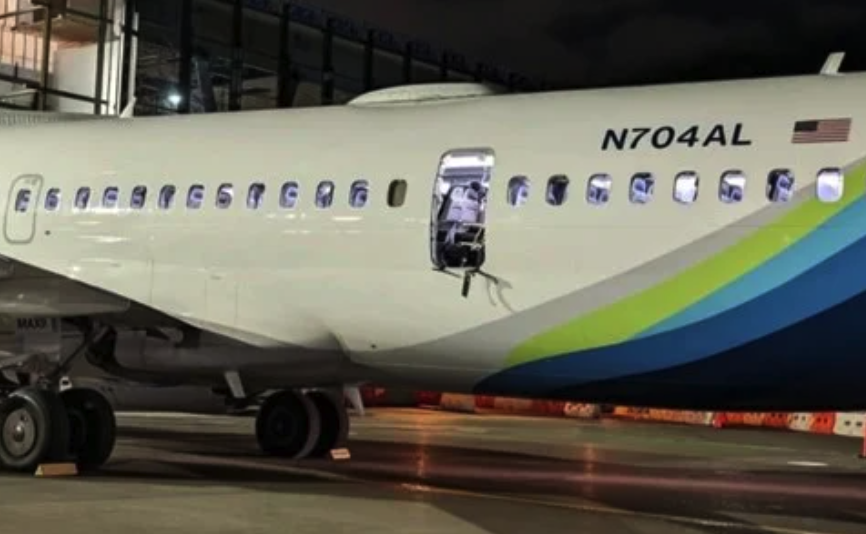
On January 5, 2024, Alaska Airlines Flight 1282, a Boeing 737 MAX 9, experienced a terrifying structural failure just minutes after takeoff. A door plug—a panel used to seal an unused emergency exit—suddenly blew out at 10,000 feet. This caused a violent cabin decompression. Thanks to the quick actions of the flight crew, the automatic oxygen system, and a bit of pure luck, all 177 people on board survived. However, the subsequent NTSB investigation exposed a shocking chain of manufacturing errors and corporate pressure at Boeing, proving that when production speed comes before safety, the safety layers protecting human lives can collapse.
An Ordinary Evening Turns into Chaos
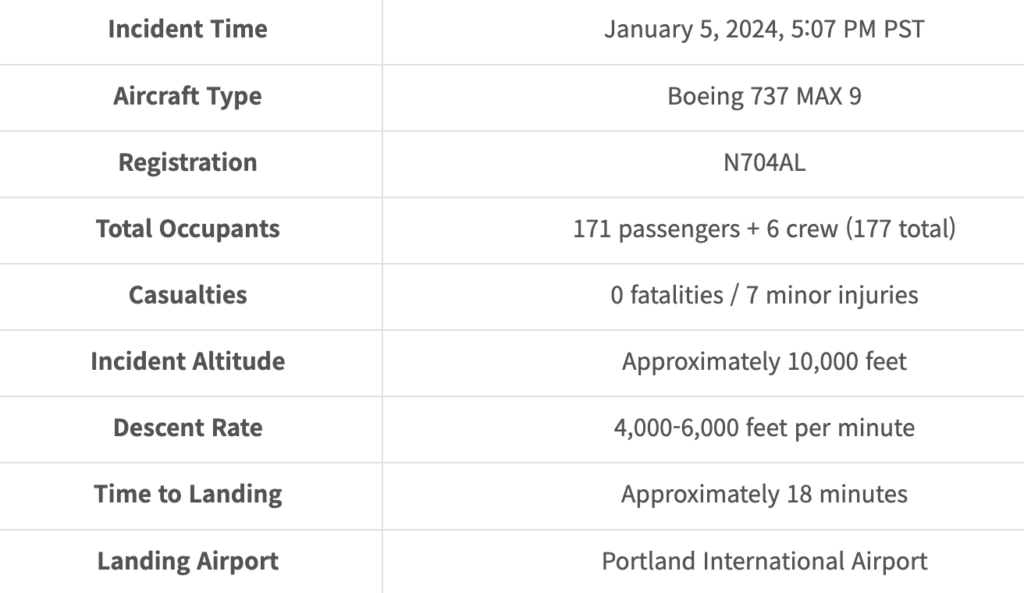
It was 5:07 PM on a chilly winter evening at Portland International Airport (PDX). Alaska Airlines Flight 1282 took off smoothly, bound for Ontario, California. On board were 171 passengers and 6 crew members. It was supposed to be a routine commuter flight.
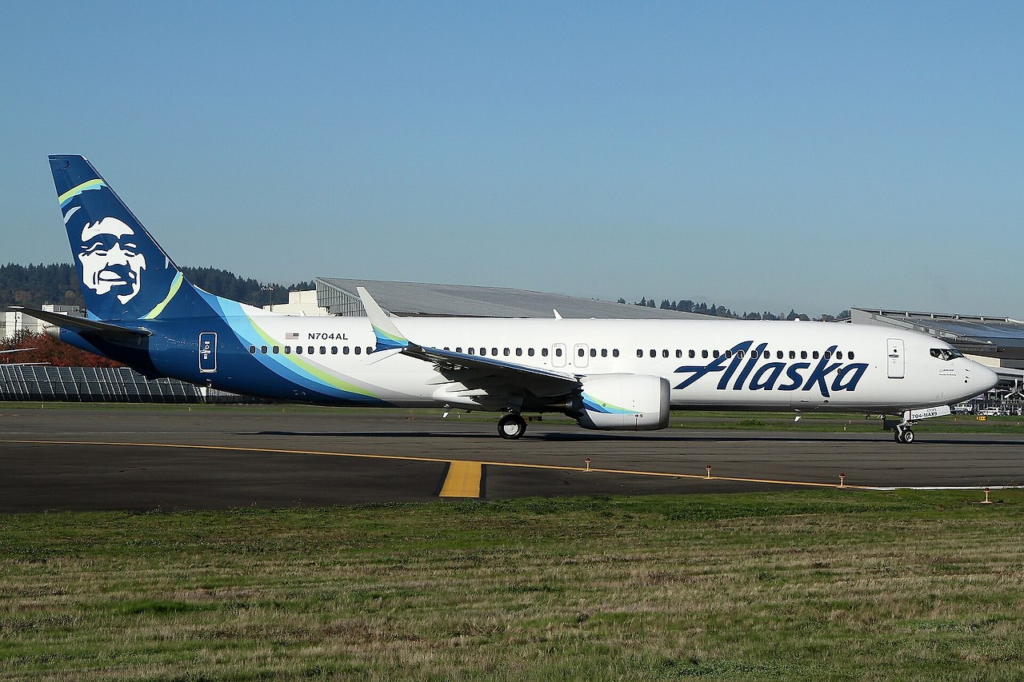
The plane, a brand-new Boeing 737 MAX 9, had been delivered to the airline just a few weeks prior. Everything was clean, functional, and operating perfectly.
Until the clock hit 5:12 PM.
As the plane climbed through 10,000 feet, a deafening explosion ripped through the cabin. A massive rush of wind swirled through the aisles. In an instant, the cockpit door flew open from the pressure change, and the flight crew received a terrifying message from the back: “There is a gaping hole in the airplane!”
The Nightmare at 10,000 Feet
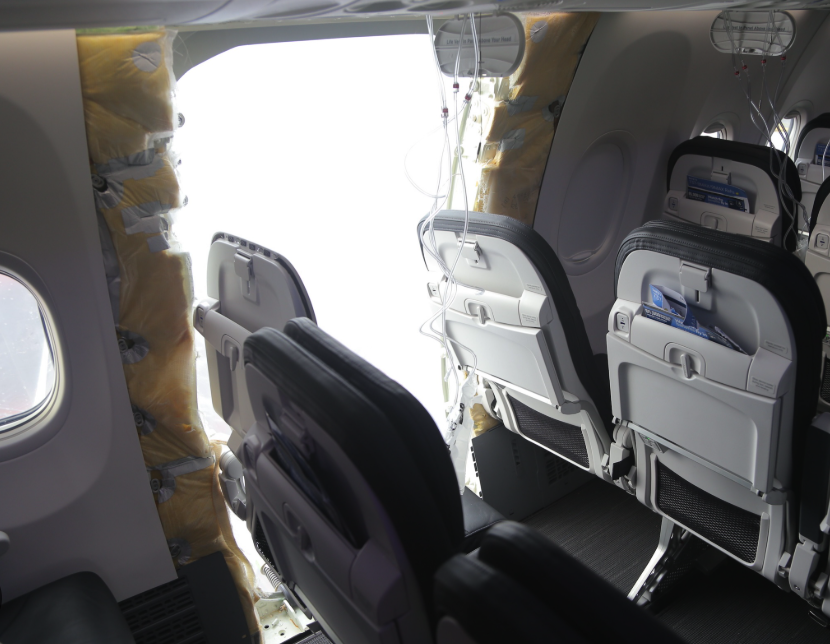
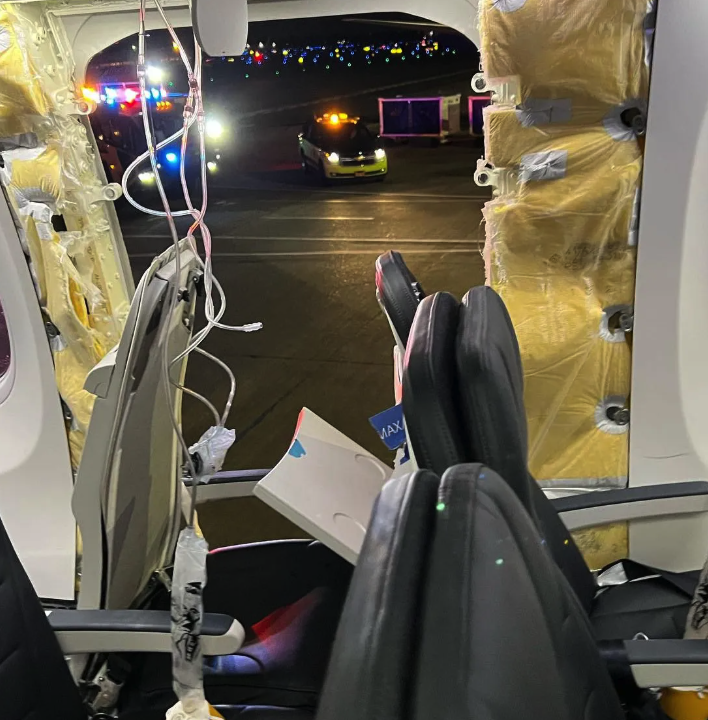
Between rows 9 and 10, a large section of the fuselage had completely vanished. It was the mid-cabin door plug—a 5.3-foot-by-2.6-foot panel designed to look like a normal window from the inside but seal an unused exit frame from the outside.
The Physics of the Blowout
Because the air inside the cabin was pressurized to keep passengers comfortable, it was pushing outward with immense force. When the structural integrity of the plug failed, the pressure differential acted like a massive vacuum.
The suction was so violent that it tore the shirts off children sitting nearby and twisted metal seatbacks. Miraculously, the two seats immediately next to the hole (26A and 26B) happened to be empty. Had anyone been buckled in tightly there, the outcome might have been fatal.
The Emergency Descent
Immediately, the yellow oxygen masks dropped from the ceiling. Recognizing the severe decompression, the captain declared an emergency and initiated a rapid descent. The pilots pushed the nose down, dropping at a rate of up to 6,000 feet per minute—twice as fast as a normal descent—to reach a safe altitude where passengers could breathe without masks.
Eighteen minutes after the blowout, through sheer professionalism and skill, the flight crew brought the damaged jetliner back down to Runway 10 at Portland International Airport. No one died, and only seven people suffered minor injuries.
The Real Problem: Why Did the Wall Fly Off?
The National Transportation Safety Board (NTSB) launched an immediate investigation. What they found shocked the aviation world. This was not a failure of complex computer software or a sudden micro-crack in the metal. It was a basic human error.
The Missing Links
Rivet Rework at Renton Factory ➔ Door Plug Opened ➔ Reinstalled WITHOUT 4 Locking Bolts ➔ Delivered to Airline ➔ Structural Failure at Cruise
The Missing Bolts
To hold the door plug securely against the immense pressures of flight, the design relies on a sequence of stop pads, lift assist springs, and four critical retaining bolts that prevent the door from sliding upward and unlocking.
During manufacturing at Boeing’s Renton assembly facility, workers had to open the door plug to fix some damaged rivets nearby. When they closed the plug back up, they forgot to reinstall the four locking bolts. The plug was held in place merely by friction and gravity. For several weeks, the plane flew routine flights, slowly vibrating until the panel finally slid upward and blew out into the Oregon night.
The Swiss Cheese Model: A Collapse of Safety Layers
Aviation safety relies on the “Swiss Cheese Model.” Every defense layer (Design, Manufacturing, Quality Inspection) is like a slice of cheese. They all have flaws (holes), but when stacked together, one layer catches what the other misses. In this accident, every single hole aligned.
Manufacturing Layer (Failed): The mechanics left out the four vital bolts.
Quality Control Layer (Failed): Because of the way the interior insulation blankets and panels cover the plug area, inspectors could not easily visually verify the bolts after the cabin interior was finished. The design itself made a final sanity-check difficult.
Corporate Culture Layer (Failed): Following the prolonged grounding of the 737 MAX in 2018–2019, Boeing was under massive financial pressure to accelerate production and catch up on delayed deliveries. This intense schedule pressure created a rushed environment where thoroughness was compromised.
Industry-Wide Shockwaves and Lessons Learned
The FAA acted with unprecedented speed, immediately grounding 171 Boeing 737 MAX 9 aircraft worldwide for emergency inspections.
Permanent Safety Fixes
By February 2024, Boeing and the FAA mandated structural changes:
Secondary Safety Locks: New physical locking pins were added to the assemblies so that even if retaining bolts are omitted, the plug mechanically cannot slide upward.
Inspection Windows: The assembly design was updated so that inspectors can clearly view the locking hardware without removing heavy interior panels.
Oversight Overhaul: The FAA placed increased in-person oversight monitors directly onto Boeing’s production floors to shift the corporate culture back toward quality over speed.
Conclusion: Trust is Earned, Safety is Built
Alaska Airlines Flight 1282 serves as a stark reminder that in aviation, there is no minor detail. A multi-million dollar high-tech jetliner can be brought down by something as simple as a few missing pieces of hardware.
We don’t fly safely because errors never happen; we fly safely because our layered systems are engineered to catch those errors before they become catastrophes. As the aviation industry moves forward, the legacy of Flight 1282 will remain a permanent reminder to manufacturers worldwide: Schedules and profits must never take priority over human lives.
Leave a Reply